Featured projects
Shared work. Specific contributions.
Customer-focused diagnostics
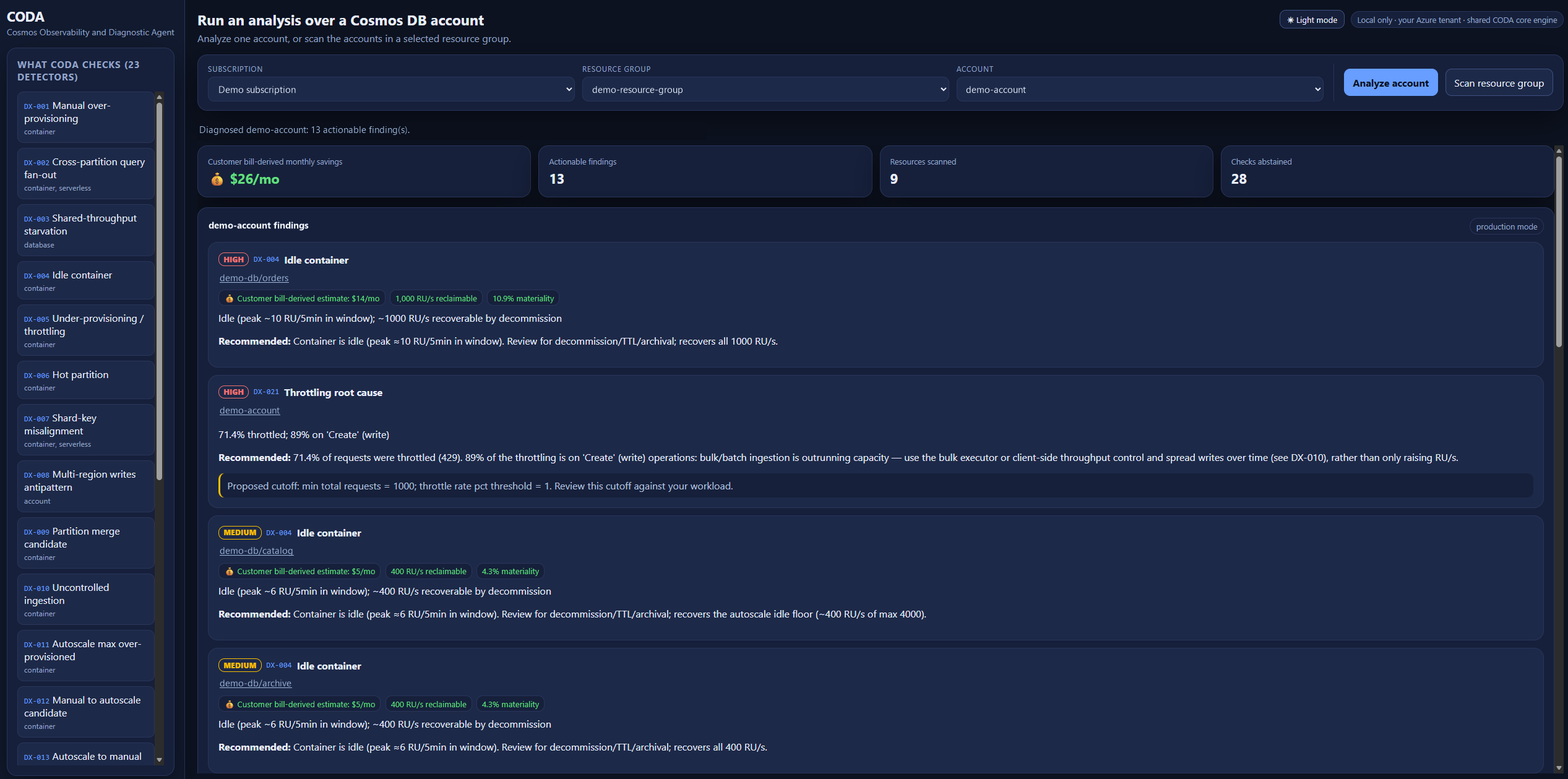
CODA - Cosmos Observability and Diagnostic Agent
A local, read-only diagnostic app that turns Cosmos DB for NoSQL configuration, metrics, and optional query logs into recommendations for throughput, partitioning, query efficiency, and cost.
Helps customers understand why their applications are slow or expensive, distinguish capacity shortages from hot partitions and inefficient queries, and evaluate targeted changes instead of simply adding throughput. Estimates savings when usable cost evidence is available.
How it works
A shared Python engine runs deterministic checks, correlates related findings, and preserves the supporting evidence while flagging checks it could not complete. Customers use a local browser UI or connect an AI assistant through MCP; the diagnostic engine itself requires no AI model.
My role
Created CODA because customers often struggle to understand and optimize the performance and cost of applications built on scale-out databases. Its diagnostic capabilities are now shipping to customers in the Cosmos DB VS Code Extension, with broader adoption planned across additional customer experiences.
Preview release. Recommendations depend on available telemetry; incomplete checks are not a clean bill of health. CODA never modifies resources or reads application documents.
 View full-size image

PostgreSQL on Kubernetes
DocumentDB: From Localhost to Multi-Cloud
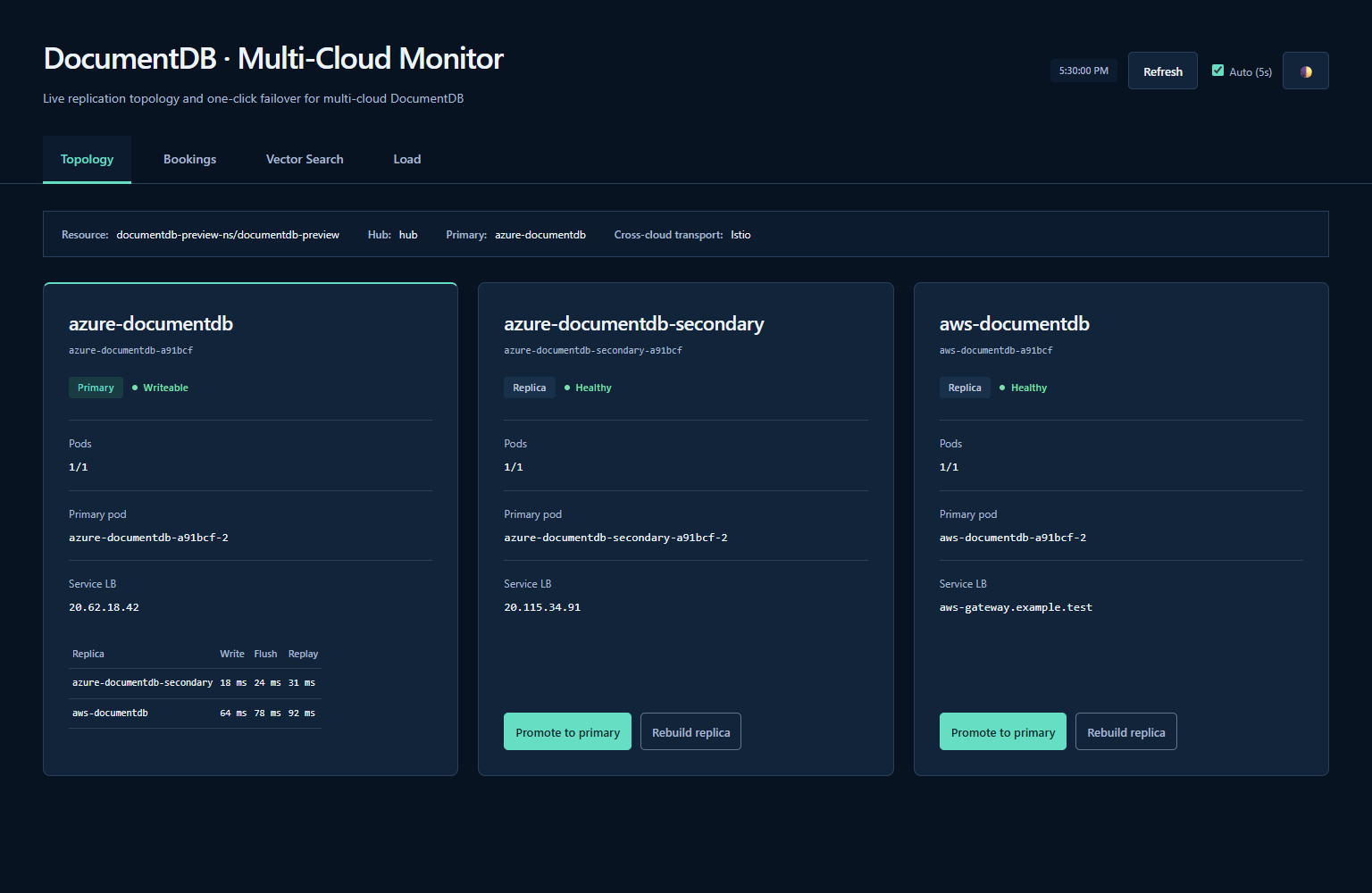
A hands-on demo of open-source DocumentDB, powered by PostgreSQL on Kubernetes. The DocumentDB operator builds on CloudNativePG to manage primary and replica clusters across Azure Kubernetes Service (AKS) and Amazon Elastic Kubernetes Service (EKS).
Makes database resilience visible through a live travel-booking workload, replication-lag monitoring, and cross-cloud failover. Developers can start locally with Docker and HNSW vector search, then explore how the database behaves across clouds.
In focus: Cross-cloud failover
PostgreSQL write-ahead logs (WAL) stream between clouds over an Istio mesh with mutual TLS. The monitor lets you promote a replica to primary with one click and watch writes move to the new primary. Grafana dashboards expose replication and workload metrics, while replica rebuild controls demonstrate recovery.
My role
Built the demo experience, including the live monitor, booking workload generator, and Grafana observability. Adapted the upstream DocumentDB multi-cloud deployment for an AKS-and-EKS walkthrough.
Built for hands-on learning and live demonstrations; production use requires additional hardening.
 View full-size image
Open-source stewardship
Azure Cosmos DB Data Migration Tool
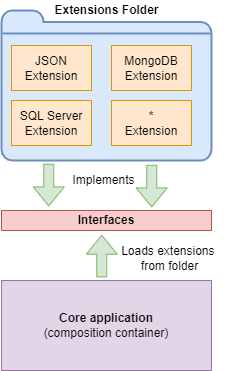
Extensible, cross-platform import and export with configurable sources and sinks.
Gives developers a way to move data between systems and extend the tool for additional formats and sources.
My role
When my team was going to deprecate an engineering owned data migration tool, I worked with a group of community members to create a new one and open source it so others could contribute as well. I launched the open-source tool and am the lead maintainer guiding contributor development.
 View full-size image

Cross-team initiative
Banking Multi-Agent Workshop
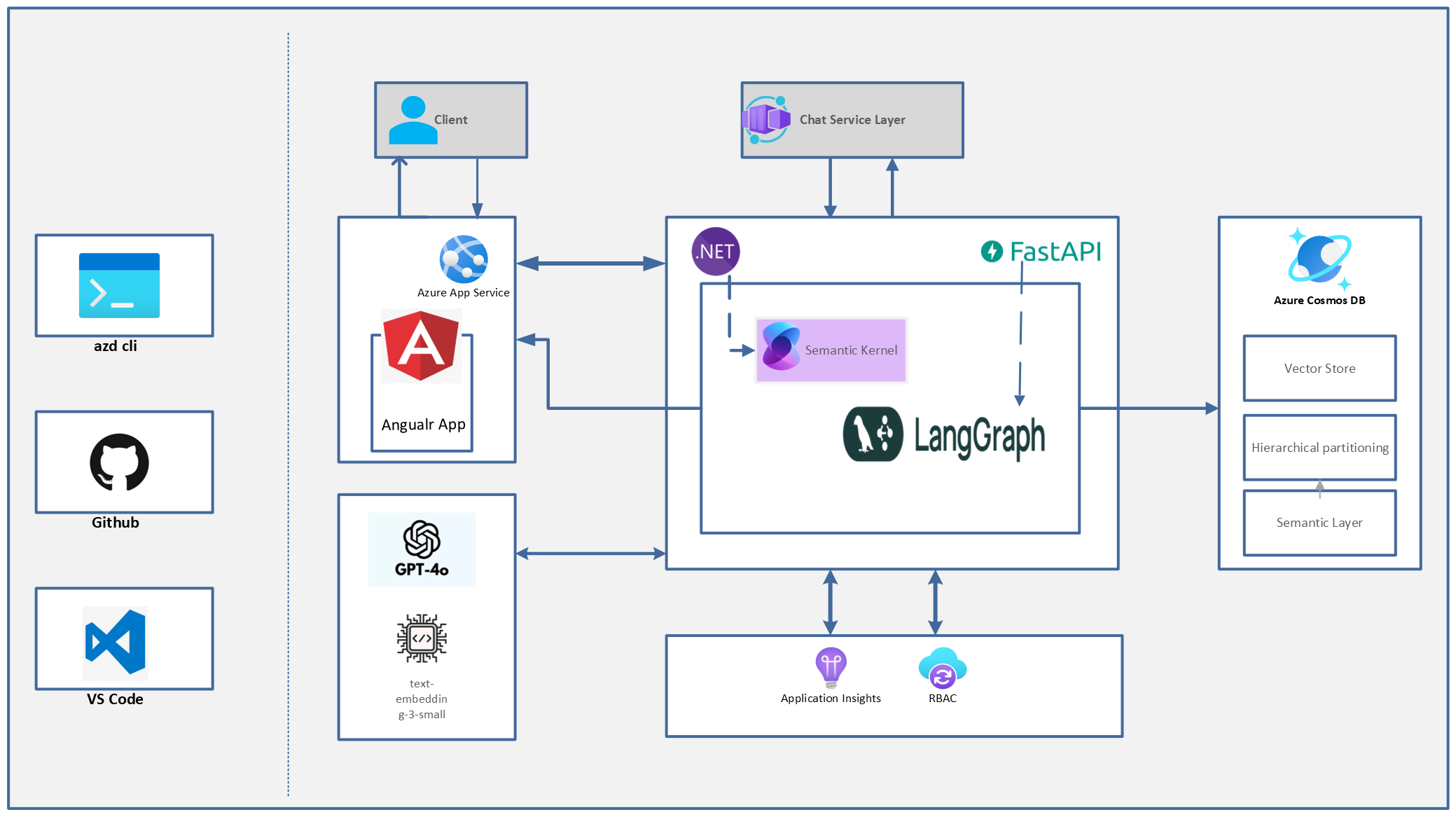
Banking scenarios that teach agent collaboration in LangGraph and Microsoft Agent Framework through exercises and reference solutions.
Helps developers work through multi-agent patterns in a concrete domain instead of starting with a blank project.
My role
Initiated the workshop, created all of the deployment infrastructure, heavily contributed to the technical content and provided cross-organizational guidance to continuing contributors.
 View full-size image

Connecting product experiences
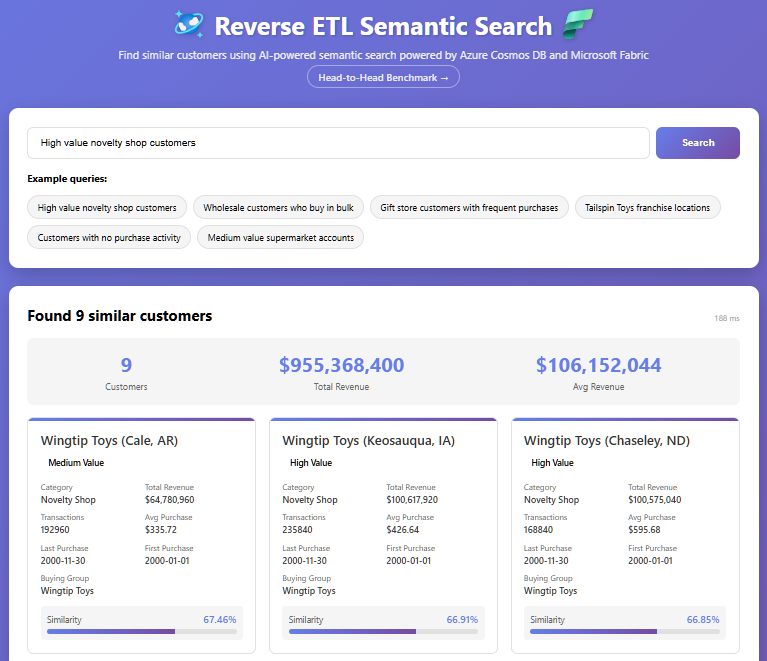
Cosmos DB in Fabric Samples
Samples covering CRUD, vector search, Spark, Power BI, reverse ETL, and translytical workflows.
Gives developers concrete ways to explore how operational data, analytics, and AI fit together.
My role
Created the samples gallery, authored most of the samples and guided fellow contributors.
 View full-size image

Extending a shared platform
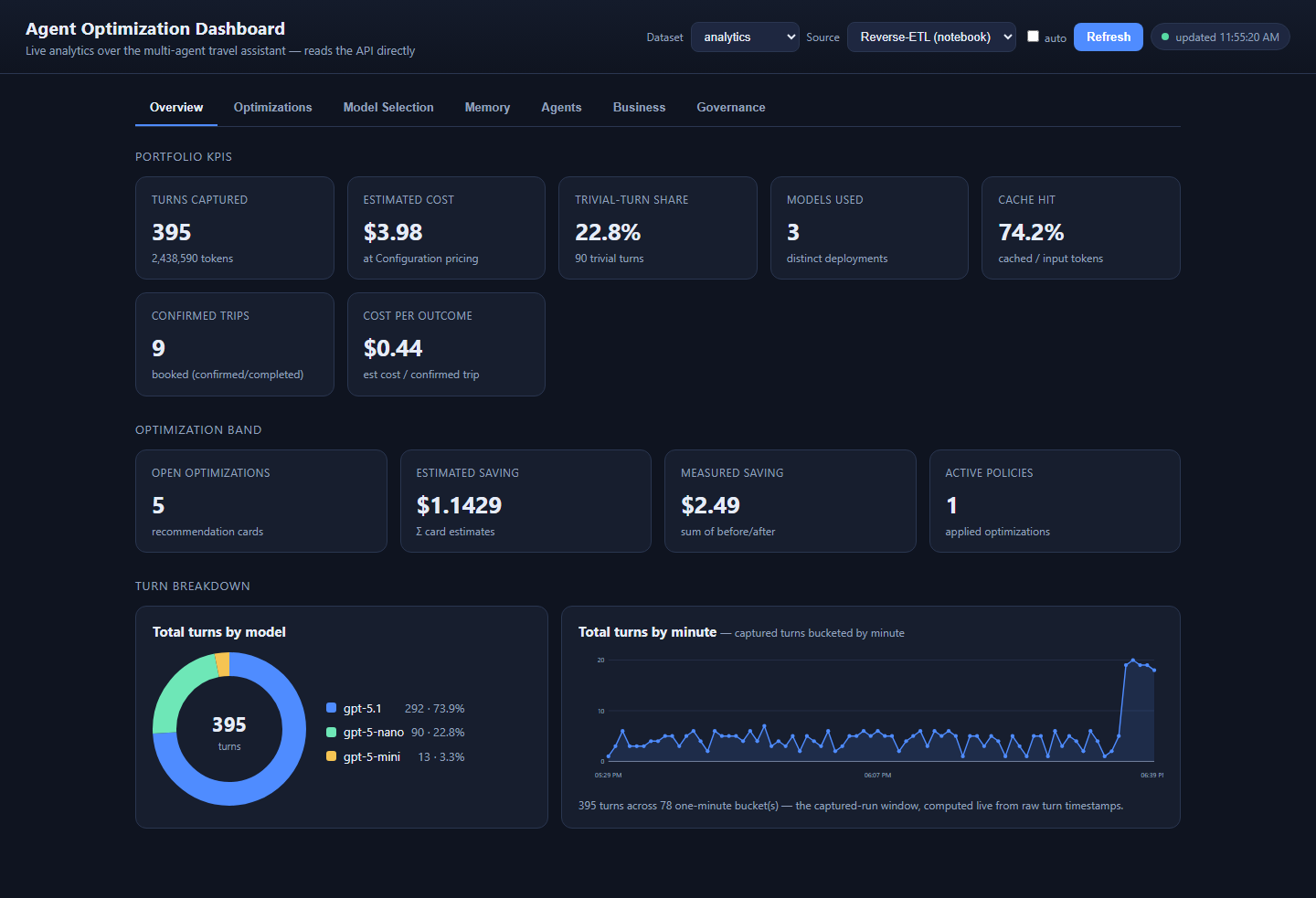
Travel Multi-Agent Workshop
A build-along travel assistant with persistent agent memory and optional Fabric modules for observability, analytics, optimization, and reverse ETL.
Lets developers explore how agent memory and analytical feedback can inform governed, reversible actions.
My role
Created the workshop/sample experience and all of the infrastructure deployment. Drove the agent analytics and optimization expansion, connecting persistent memory with Fabric insights and governed, reversible actions.
 View full-size image

Developer learning
Cosmos DB Design Patterns
Runnable NoSQL data-modeling and architecture examples covering concurrency, partitioning, event-driven designs, and vector search.
Helps developers explore coordination and failure scenarios in working code, making distributed-systems design choices easier to understand.
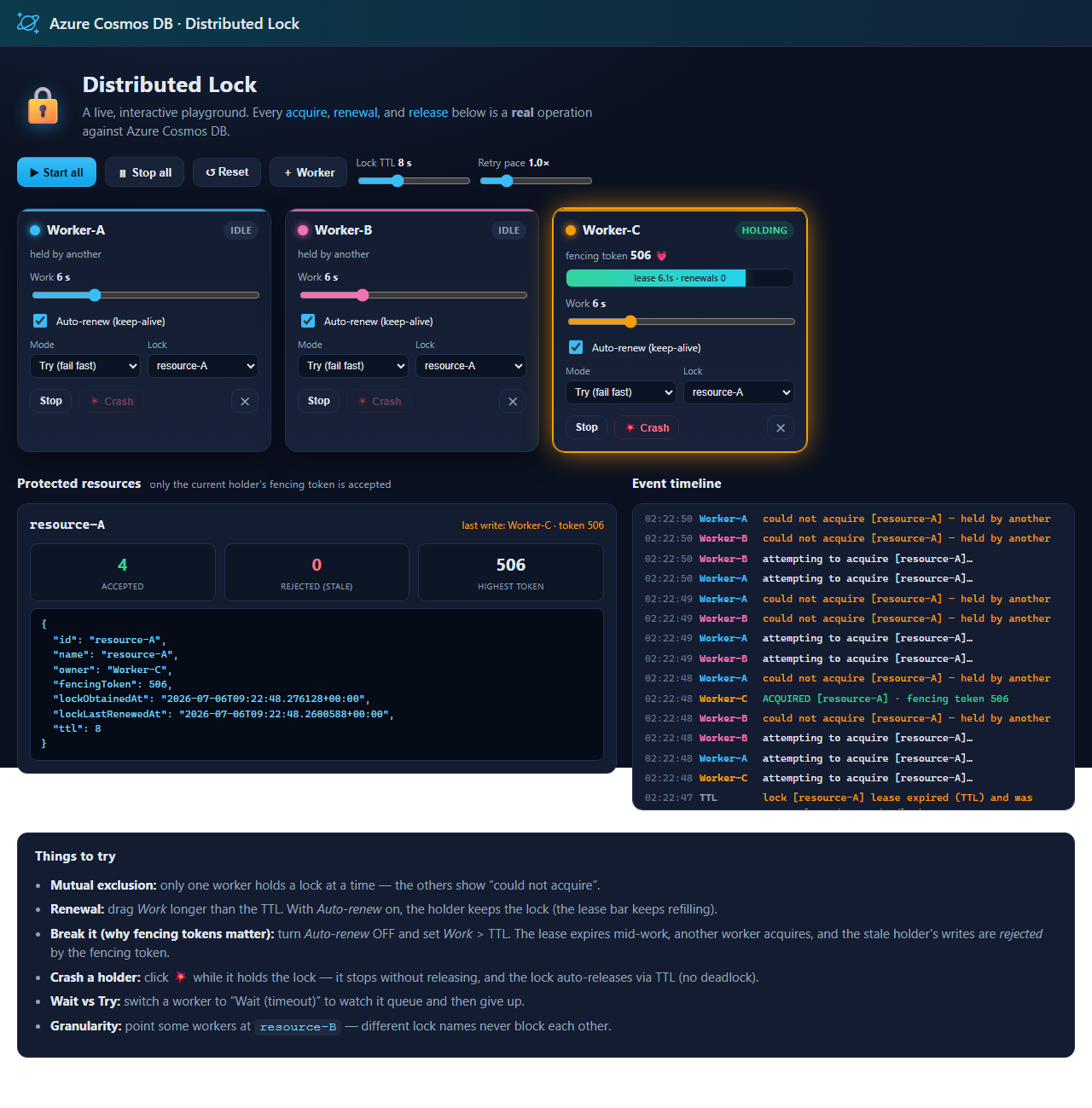
In focus: Distributed lock
An interactive playground makes lock contention, lease renewal, crash recovery, and fencing-token protection visible through competing workers backed by Cosmos DB.
My role
Initiated this project and was a major contributor, expanding practical examples and improving the developer learning experience.
 View full-size image

More from the workbench
Architecture & deployment
Focused examples that make infrastructure choices and distributed-systems trade-offs easier to explore.
Focused deployment example
Cosmos Web App Network Sample
A public-facing web app connected to Cosmos DB through private networking and managed identity.
Helps developers compare Private Link with service-endpoint and VNet-rule connectivity in a deployable example.
My role
Authored the deployment sample.
Architecture learning · Earlier work
Cosmos Global Distribution Demos
Hands-on demonstrations of consistency, latency, replication, conflict resolution, and failover trade-offs.
Makes distributed-systems behavior easier to reason about through concrete experiments.
My role
Primary contributor to hands-on distributed-systems demonstrations.
Older architecture-learning material targeting earlier .NET versions—not a current production starter.
These projects include work by many people. I've described my own role rather than claiming the whole effort.
More on GitHub